What Do Hp(10), Hp(3), Hp(0.07), and Hp*(10) Mean?
Cele mai citite
What Do Hp(10), Hp(3), Hp(0.07), and Hp*(10) Mean?
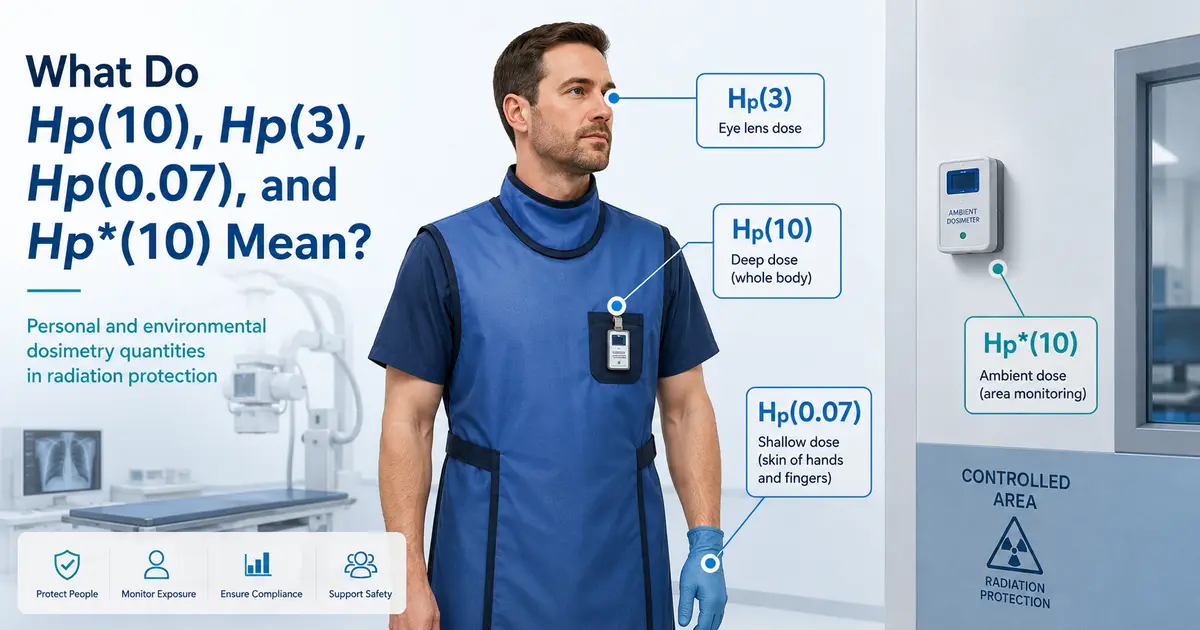
When you receive a dosimetric report, you may notice values written as Hp(10), Hp(3), Hp(0.07), or Hp*(10). For many people, these terms may seem complicated at first. In reality, they are dosimetric quantities used to evaluate exposure to ionizing radiation.
In short, these values indicate what type of exposure is being monitored: whole-body exposure, eye lens exposure, skin and extremity exposure, or the radiation level in a specific working area.
Understanding these quantities helps occupationally exposed workers, employers, and radiation protection officers correctly interpret dosimetric results and maintain activities under safe and compliant conditions.
What does Hp mean?
The notation Hp(d) means personal dose equivalent, while the value in brackets indicates the depth, expressed in millimeters, at which the dose is evaluated in tissue.
This depth is important because radiation does not interact with all tissues in the same way. Some types of radiation penetrate deeper into the body, while others mainly affect the skin, eyes, or extremities.
For this reason, dosimetric monitoring uses several quantities, depending on the exposed area, the type of radiation, and the associated radiological risk.
Hp(10) — dose for the whole body
Hp(10) is used to estimate the deep dose at a depth of 10 mm below the skin. This quantity is commonly associated with monitoring whole-body exposure.
Hp(10) is especially relevant for penetrating radiation, such as X-rays, gamma radiation, or neutrons, which can reach internal organs.
For this reason, the Hp(10) value frequently appears on the dosimetric reports of workers in radiology, dentistry, industry, non-destructive testing, research, or other fields where occupational exposure to ionizing radiation may occur.
When is Hp(10) monitored?
Hp(10) is usually monitored with a personal whole-body dosimeter. This dosimeter is worn according to the instructions established for the workplace and the type of activity performed.
Examples of situations where Hp(10) is relevant include:
- personnel working in medical or dental radiology;
- personnel working with CT, fluoroscopy, or X-ray equipment;
- personnel in veterinary clinics using radiological equipment;
- workers in industry or non-destructive testing;
- personnel carrying out activities near sources of ionizing radiation.
For the reported value to be relevant, the dosimeter must be worn correctly and consistently. A dosimeter left inside the radiology room, worn by another person, or positioned incorrectly may lead to results that do not reflect the worker’s actual exposure.
Hp(3) — dose for the eye lens
Hp(3) is used to estimate the dose to the eye lens, at a depth of 3 mm. This quantity is important because the eye, especially the lens, can be sensitive to repeated exposure to ionizing radiation.
Hp(3) monitoring is particularly relevant in activities where the worker is close to the patient or to the source of scattered radiation. In such situations, the head and eye area may be more exposed than in routine radiological activities.
Who may need eye lens monitoring?
Eye lens monitoring may be necessary especially for:
- physicians and personnel working in interventional radiology;
- interventional cardiologists;
- urologists working with image-guided procedures;
- angiography personnel;
- personnel frequently involved in fluoroscopy procedures;
- other categories of workers who may have increased exposure at eye level.
In these cases, Hp(3) monitoring can be combined with protective measures such as lead glasses, suspended shields, or optimization of the worker’s position in relation to the patient and the source of scattered radiation.
Hp(0.07) — dose for skin and extremities
Hp(0.07) is used to estimate the superficial dose at a depth of 0.07 mm. This quantity is relevant for the skin and extremities, especially the hands and fingers.
Unlike Hp(10), which refers to deep exposure, Hp(0.07) is important when radiation mainly affects the superficial layers of the skin or areas that come close to the source.
When is Hp(0.07) important?
Hp(0.07) is important in activities such as:
- nuclear medicine;
- handling radiopharmaceuticals;
- working with open radioactive sources;
- laboratories where radioactive materials are handled;
- certain industrial or research activities;
- situations where the hands may come close to the radiation source.
Special dosimeters, such as ring dosimeters worn on the finger, may be used for extremity monitoring. These help assess hand exposure in activities where a whole-body dosimeter would not adequately reflect the local dose.
Hp*(10) — area or ambient monitoring
In addition to personal monitoring of workers, radiation protection also uses area monitoring or ambient monitoring. This type of monitoring does not assess the dose received by a specific person, but rather the radiation level present in a particular area.
For this evaluation, the quantity Hp*(10) is used, also known as the ambient dose equivalent at 10 mm. It is used to assess the radiation field in a working area, radiology room, controlled area, or near a source of ionizing radiation.
In other words, while Hp(10), Hp(3), and Hp(0.07) are associated with personal monitoring, Hp*(10) is associated with monitoring the working environment.
When is Hp*(10) used?
Hp*(10) monitoring can be useful in several situations:
- checking radiation levels in a radiology room;
- monitoring controlled or supervised areas;
- evaluating exposure near X-ray, CT, or CBCT equipment;
- area monitoring in laboratories or industrial spaces;
- verifying the effectiveness of shielding measures;
- monitoring radiation levels at a fixed point of interest;
- documenting radiological conditions in a working area.
An area dosimeter does not replace a personal dosimeter, because it does not measure the individual dose received by a worker. However, it provides important information about the working environment and possible changes in radiation levels at a specific point.
The difference between Hp(10), Hp(3), Hp(0.07), and Hp*(10)
These four quantities do not exclude one another. They answer different questions.
Hp(10) answers the question:
What deep dose did the worker receive at whole-body level?
Hp(3) answers the question:
What dose did the eye lens receive?
Hp(0.07) answers the question:
What superficial dose did the skin or extremities receive?
Hp*(10) answers the question:
What is the radiation level in a specific area or monitoring point?
For example, in a typical dental clinic, whole-body monitoring may be sufficient, depending on the risk assessment and working method. In interventional radiology, eye lens monitoring may also be necessary, while in nuclear medicine, extremity monitoring may also be required.
Separately, in a radiology room, an area dosimeter may be used to monitor the radiation level at a fixed point or to track radiological conditions in that space.
Dose limits for occupationally exposed workers
For occupationally exposed workers, dose limits are established by the applicable radiation safety regulations. In practice, dosimetric monitoring helps verify that exposure remains below these limits and that radiation protection measures are effective.
For the whole body, the annual limit is 20 mSv/year.
For the eye lens, the annual limit is 20 mSv/year.
For skin and extremities, the annual limit is 500 mSv/year.
These limits should not be viewed as target values. In radiation protection, the objective is not to approach the limit, but to keep exposure as low as reasonably achievable, depending on the activity performed and in accordance with the ALARA principle.
For Hp*(10), interpretation is different because it does not refer to the individual dose received by a person, but to a radiation level associated with an area or monitoring point. The results are used to evaluate radiological conditions and verify the effectiveness of protection measures.
Why can different values appear on the dosimetric report?
Hp(10), Hp(3), Hp(0.07), and Hp*(10) values may differ because they evaluate different things.
For example, a worker may have a low Hp(10) value but a more relevant Hp(3) value if they frequently work close to scattered radiation during interventional procedures.
Similarly, in nuclear medicine, the dose to the hands may be more important than the whole-body dose, because handling radiopharmaceuticals may lead to local exposure of the fingers.
At the same time, an area dosimeter may indicate different levels compared with personal dosimeters, because it remains in a fixed position and monitors the environment, not the person.
Correct dosimeter positioning matters
Correct interpretation of dosimetric values also depends on the correct wearing or placement of dosimeters.
For personal dosimeters, a dosimeter worn incorrectly, left inside a radiology room, or stored near a radiation source may produce results that do not reflect the worker’s actual exposure.
For area dosimeters, placement is just as important. They must be positioned at relevant points for evaluating the monitored space, so that the results can be interpreted correctly.
For this reason, each worker must follow the instructions received from the radiation protection officer and the dosimetry service. The dosimeter is personal, must not be shared, must not be intentionally exposed, and must be returned on time for reading.
How do these values help the employer and the radiation protection officer?
Hp(10), Hp(3), Hp(0.07), and Hp*(10) values are not important only for the monitored person. They also help the employer and the radiation protection officer understand whether the activity is being carried out under controlled conditions.
By analyzing dosimetric results, it is possible to identify:
- unusual values;
- possible errors in dosimeter wearing;
- accidental exposure of dosimeters;
- work procedures that require optimization;
- the need for additional protective equipment;
- the need for additional eye lens or extremity monitoring;
- changes in radiation levels in a specific area;
- the need for additional verification of shielding or workplace organization.
A dosimetric report should be regarded as a control and prevention tool, not just as an administrative document.
Q RAD Laboratory — whole-body, eye lens, extremity, and area monitoring
Q RAD Laboratory provides dosimetric monitoring services for occupationally exposed workers, including whole-body monitoring, eye lens monitoring, extremity monitoring, and ambient monitoring, depending on the specific activity.
Through its own resources and through authorized strategic partners, Q RAD can support organizations working with ionizing radiation throughout the radiation protection process: dosimetric monitoring, documentation, equipment, training, preparation for inspections, and continuous operational support.
If you are not sure what type of monitoring is required for your activity, Q RAD Laboratory can help you identify the appropriate solution based on the radiological risk, the specific nature of the activity, and the applicable requirements.
Conclusion
Hp(10), Hp(3), Hp(0.07), and Hp*(10) are essential quantities for understanding exposure to ionizing radiation.
Hp(10) is associated with whole-body exposure, Hp(3) is used for the eye lens, Hp(0.07) is relevant for skin and extremities, and Hp*(10) is used for area or ambient monitoring.
A dosimetric report is not just an administrative document, but a technical overview of exposure and radiological conditions. When interpreted correctly, it helps protect workers, maintain compliance, and continuously improve radiation protection measures.