Time, Distance and Shielding: 3 Simple Principles That Reduce Radiation Exposure
Cele mai citite
Time, Distance and Shielding: 3 Simple Principles That Reduce Radiation Exposure
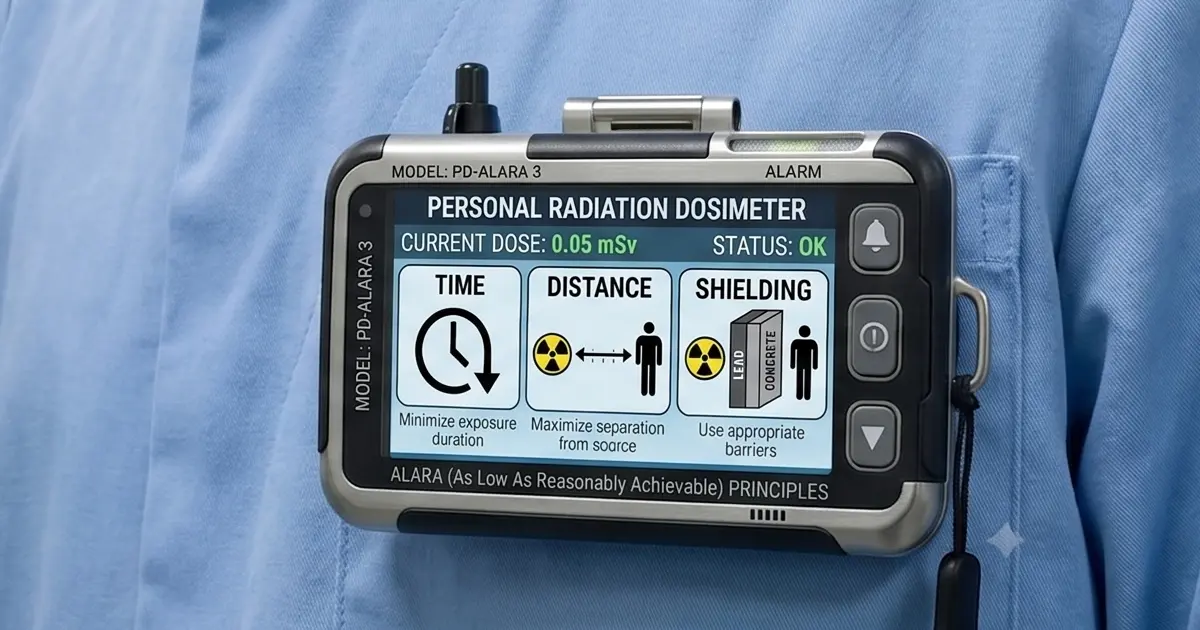
Radiation protection may seem like a complex field, involving regulations, documents, authorizations, doses, dosimeters, and technical checks. However, at its foundation are three very simple principles: time, distance, and shielding.
These principles are used internationally to reduce exposure to ionizing radiation and apply in many areas: medical radiology, dentistry, veterinary medicine, nuclear medicine, industry, NDT, and laboratories using radioactive sources. EPA presents time, distance, and shielding as essential radiation protection principles.
The idea is straightforward: exposure can be reduced by spending less time in a radiation field, increasing the distance from the source, and placing an appropriate barrier between the person and the source.
What does ALARA mean?
In radiation protection, the term ALARA is frequently used. It stands for As Low As Reasonably Achievable.
ALARA does not mean that every activity involving radiation must be avoided. It means that exposure should be justified, organized, and optimized so that doses are kept as low as reasonably achievable without compromising the purpose of the activity.
For an occupationally exposed worker, ALARA means:
- not remaining unnecessarily near a source;
- using the maximum practical distance;
- using available protective equipment;
- following procedures;
- wearing the dosimeter correctly;
- reporting unusual situations;
- participating in real training, not only formal training.
CDC describes ALARA as an approach to keeping radiation exposure as low as reasonably achievable, with time, distance, and shielding used as basic protective measures.
1. Time: the less time spent near radiation, the lower the exposure
The first principle is time. In general, if the dose rate remains constant, the accumulated dose increases with the time spent in the radiation field.
In other words, if a person remains unnecessarily near a source, near the patient during exposure, or in an area with scattered radiation, their exposure may increase.
Reducing time does not mean rushing or working carelessly. It means being organized.
Practical examples:
- preparing the procedure before exposure;
- checking patient positioning before activating the equipment;
- avoiding unnecessary repeat exposures;
- using correct protocols;
- allowing only essential personnel to remain in the room;
- avoiding unnecessary presence in controlled areas;
- ensuring clear communication between team members.
In radiation protection, time lost through poor organization can become unnecessary dose.
2. Distance: one of the simplest protection methods
Distance is one of the most effective and easiest ways to reduce exposure.
In many situations, a simple change in position can significantly reduce the dose received by personnel. For X-rays and gamma radiation, increasing the distance from the source reduces exposure, and the inverse square principle is used in radiation protection to estimate the decrease in radiation intensity. OSHA specifically mentions the use of distance and shielding as control measures for reducing worker exposure to ionizing radiation.
Practical examples:
- the operator stands in the protected area;
- personnel move to the maximum practical distance;
- unnecessary positioning near the patient is avoided;
- remote controls are used where possible;
- in mobile procedures, a safe position is selected;
- in interventional radiology, ceiling-suspended and lateral shields are used correctly;
- in industry/NDT, the safety perimeter is respected.
Distance costs nothing, but it must be used consciously.
3. Shielding: the barrier between the person and the source
Shielding means placing a suitable material between the person and the radiation source. Depending on the type of radiation, its energy, and the activity performed, shielding can take different forms.
In practice, shielding may include:
- properly designed walls;
- shielded doors or windows;
- mobile barriers;
- ceiling-suspended shields;
- protective aprons;
- thyroid collars;
- protective eyewear;
- containers for radioactive sources;
- local protection in specific beam directions.
Shielding must be selected correctly. Not every situation requires the same lead thickness, and not every material is suitable for every type of radiation.
A protective apron, for example, may be very useful in certain activities, but it should not replace distance, correct positioning, or reduced time. Radiation protection works best when these measures are applied together.
Time, distance and shielding in medical radiology
In medical radiology, these principles are applied every day.
For personnel, they may involve:
- leaving the exposure room when presence is not necessary;
- using a protective barrier;
- wearing personal protective equipment;
- correct positioning during procedures;
- avoiding repeat exposures;
- following working protocols;
- organized dosimetric monitoring.
For the patient, these principles are applied through examination justification, protocol optimization, collimation, appropriate parameter selection, and avoidance of unnecessary exposure.
Radiation protection does not mean refusing necessary procedures. It means performing them correctly, with optimized exposure.
Time, distance and shielding in dentistry
In dental clinics, these principles are highly practical.
Examples include:
- the operator stands outside the useful beam;
- the maximum distance allowed by the exposure cable is used;
- the patient is positioned correctly before exposure;
- repeat images caused by poor positioning are avoided;
- manufacturer instructions are followed;
- the room is assessed before equipment installation;
- shielding is based on calculation, not assumptions.
For panoramic and CBCT systems, protocol optimization is particularly important. Field of view, exposure parameters, and clinical indication must be selected correctly.
Time, distance and shielding in veterinary medicine
Veterinary medicine has specific challenges because animals may sometimes need to be positioned or immobilized during imaging.
Risk may increase when staff remain close to the patient unnecessarily or when protective measures are not used correctly.
Useful measures include:
- sedation of the animal when justified and possible;
- using supports or positioning aids;
- reducing the number of people present in the room;
- wearing protective equipment;
- keeping hands outside the useful beam;
- using the maximum possible distance;
- wearing dosimeters correctly.
In veterinary radiology, organizing the procedure before exposure is essential.
Time, distance and shielding in industry and NDT
In industry and NDT, sources may have high activity or high energy, and radiation protection rules must be applied strictly.
The principles are especially important for:
- setting up safety perimeters;
- access control;
- reducing time spent in areas with dose rate;
- using remote controls or remote systems;
- storing sources in appropriate containers;
- using shields or barriers;
- checking the area before and after exposure;
- dosimetric monitoring and area surveillance.
In such activities, operational discipline is as important as the equipment used.
The three principles must be applied together
A common mistake is applying only one principle while ignoring the others.
For example:
- wearing a protective apron does not justify standing unnecessarily near the source;
- distance does not remove the need for shielding where shielding is required;
- reducing time does not replace correct procedures;
- room shielding does not mean that a dosimeter is no longer needed;
- having a dosimeter does not reduce dose; it only monitors it.
Effective radiation protection appears when time, distance, and shielding are integrated into normal work.
What is the role of the dosimeter?
The dosimeter is not a protective device by itself. It does not reduce dose, but it helps monitor occupational exposure.
Its role is to provide information about worker exposure, support dosimetric history, and help identify unusual situations.
A dosimeter must be:
- worn correctly;
- assigned to a single person;
- stored properly;
- returned on time;
- reviewed after reading;
- correlated with the activity performed.
An incorrectly worn dosimeter may provide an inaccurate picture of exposure.
Practical checklist for personnel
Before starting work, ask yourself:
- Do I need to remain in the exposure area?
- Can I reduce the time spent near the source?
- Can I stand farther away?
- Is there a barrier or shield I can use?
- Am I wearing my dosimeter correctly?
- Am I using the required protective equipment?
- Do I know what to do in an unusual situation?
- Is the procedure clear?
- Are there people in the room who do not need to be there?
- Are the exposure parameters appropriate?
These simple questions can help prevent unnecessary exposure.
How can Q RAD Laboratory help?
Q RAD Laboratory supports organizations carrying out activities involving ionizing radiation through integrated radiation protection, dosimetric monitoring, and technical support services.
We can help with:
- personal dosimetric monitoring;
- establishing the required types of dosimeters;
- staff training on correct dosimeter use;
- review of radiation protection documentation;
- preparation for CNCAN inspections;
- supply of radiation protection equipment;
- support in selecting shielding solutions;
- cooperation with authorized experts and partners for technical checks;
- organization of records and procedures;
- continuous operational support.
Through our own resources and authorized strategic partners, Q RAD can become a single point of contact for organizations that want to work correctly, safely, and in compliance in environments involving ionizing radiation.
Conclusion
Time, distance, and shielding are simple but extremely important principles. When applied correctly, they can reduce personnel exposure, improve operational safety, and support a real radiation protection culture.
Radiation protection does not have to be complicated. It has to be understood, applied, and monitored continuously.
Q RAD Laboratory can support your organization in implementing practical radiation protection measures adapted to the real activity and applicable requirements.
This article provides general information. Exact requirements depend on the type of practice, installations used, authorization conditions, and applicable regulation